
Ammonia is the most important gas healthwise found in swine buildings
on a day-to-day basis because it can occur at levels high enough to be an
irritant to the respiratory system. The recommended maximum gas concentrations
suggested by OSHA (25 ppm) are much higher than those suggested by agricultural
scientists in Europe (10 ppm).
Many studies have been done over the last several years in Europe and North
America to see what can be done to reduce indoor levels of ammonia gas through
building design and management practices, Table 1. From these studies, it
doesn't seem like any single solution will do the job satisfactorily. Ammonia
gas can be significantly reduced if the right things are done simultaneously
with available methods and management practices that involve ventilation,
manure management, building hygiene, and feed management. Implementing these
strategies for ammonia reduction in swine buildings may also reduce other
manure gases and odors.
Ventilation
Since additional airflow reduces contaminant levels, ammonia control should
be considered when choosing the minimum ventilation rate. Proper ventilation
will also require uniform distribution of fresh air into the room. Air circulation
fans or distribution ducts improve the mix of indoor air during the winter.
Air speeds across manure-covered surfaces should be minimized since the
amount of ammonia gas given off by manure is increased with air speed. In
one experiment with 165 lb pigs, increasing the air change rate from 2 to
4 air changes per hour increased the quantity of ammonia released from 250
to 350 mg/hour.
The design, location, and management of ventilation inlets can affect air
speeds across the floor and over the pit surface. Make sure the inlets are
working properly. Most incoming air jets in cold weather should travel across
the ceiling first and then down to the floor. By that time, the speed of
the fresh air is quite low. Exposed purlins and ceiling fixtures can prematurely
detach an air jet from the ceiling and direct it down to the floor at relatively
high air speeds. Air inlets that direct incoming air down the wall can therefore
increase ammonia emissions into the room.
Ventilation fans that exhaust air directly from the pit reduce manure gas
concentrations in the room. When measurements of hydrogen sulfide were taken
with pit ventilation during manure agitation, the concentrations were around
150 ppm under the floor and only about 5 ppm above the floor. Without pit
ventilation, gas concentrations in the occupied parts of the room would
Have been dangerously high.
Air exhaust from the pit is not likely to increase air velocities across
the manure surface unless it is within two or three diameters away from
the discharge hole in a duct or the exhaust fan. Do not overfill a pit under
slotted floors--leave at least 12 inches between the bottom of slat supports
and the top of the manure.
There will be some ammonia in the room even with well-designed pit ventilation,
because ammonia offgassing will also come from urine and manure that accumulates
on the slats and other room and equipment surfaces. In some cases, the pit
contributes only a minor portion of total ammonia gas. Keep bedding, animal
pens, and feeding areas dry to slow down manure decomposition. Ventilate
to dry wet areas quickly or add new bedding.
Make sure fresh air doesn't enter the building through the manure pit, e.g.
through uncovered pump-out ports. This may happen with wind-induced back
pressure on the pit ventilation fans, especially variable-speed pit fans
which are extremely vulnerable to wind at low speeds, e.g. < 50% of maximum.
Include an air trap in drain lines to reduce backdraft of manure gases from
an outside storage.
Another situation which probably occurs more frequently is ventilation air
entering and leaving the pit. High speed air, in spite of pit ventilation,
will "scour" ammonia gas into the room. Reduce the speed of air
entering the pit to avoid this problem. For this reason, duct-type pit ventilation
is probably more effective than fans only.
Wet scrubbing reduced ammonia levels by 40% in recent tests. Air was forced
up through a shaft filled with thousands of small pieces of inert plastic,
against a downward flow of water. It also removed a significant amount of
dust particles, bacterial and fungal spores,
and carbon dioxide. Scrubbers can also remove more than 90% of odorous gases;
however, the technique is relatively expensive at the present time.
Manure Management
To reduce ammonia levels, avoid storing manure in the building for long
periods. The rate of ammonia released from manure increases for storage
times longer than about one day. However, there are no further reductions
in ammonia release rates for less than one day because so much comes from
dirty surfaces (slats, floor, animals, etc.). Ammonia production peaks at
three days and again at 21 days. Frequent manure removal helps maintain
low ammonia gas levels. Removing manure frequently to reduce ammonia is
more effective with poultry than with swine because ammonia formation takes
place mainly from the swine's urine. This occurs so rapidly that cleaning
intervals in swine buildings would have to be at least half-hourly and the
urine, in particular, would have to be removed as completely as possible.
This can be done efficiently only with flushing systems since surface scrapers
always leave behind a film of urine on the surface, from which emission
takes place. European researchers are developing gutter scrapers that automatically
separate the liquid from the solids.
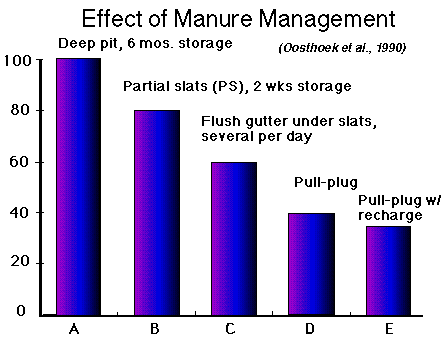
Researchers in The Netherlands compared the relative ammonia emissions
for five different manure collection systems, Figure 1. Total slotted floors
with deep pit and long-term storage generated the most ammonia gas. The
building with a partially slatted floor and manure pit produced 20% lower
ammonia emissions. A partly-slatted floor combined with a sloping floor
under the slats from which manure was flushed several times a day was 30%
below that for a deep pit. Greater emission reductions were achieved when
manure was collected under the slatted floor in about 4 inches of flushing
water so manure that falls into liquid and solids are submerged. If the
mixture was regularly pumped out and replaced by new flushing liquid (as
in pit recharge), the reduction was 60%.
Using the "pull plug with recharge" or "fill and empty"
principle of manure removal, the reduction increased to 70%. In this last
case, pipes were laid under the floor of the manure pit leading to the outside
manure storage. Inlets to these drain pipes were placed at regular intervals
in the floor. The drains could be closed with plugs, shut-off balls, or
gate valves. When opened, the slurry or flushing liquid flowed out without
significant surface turbulence into the outside liquid manure storage. The
openings are then closed and new flushing liquid added to the pit. The results
of these tests agree with Canadian researchers who stated that there is
no advantage to continuous flow gutters, flush gutters, or scraped gutters
over fill-and-empty gutters in terms of ammonia production.
Treatment of liquid manure pits to reduce offgassing will have one of the
following objectives: (1) to develop an aerobic system, (2) to enhance anaerobic
conditions, or (3) to stop microbial activity. Aerobic systems involve the
use of aeration pumps and continual agitation, and have high energy and
maintenance costs. Additionally, restarting aeration following repairs of
the system can cause acutely toxic conditions by stripping out anaerobic
gases that have built up in the manure.
Proper conditions in the pit for anaerobic conditions will reduce the build-up
of both solids and toxic gas. Anaerobic conditions are difficult to attain
because the loading rates, solids content, ammonia content, buffering capacity,
and temperature must all be favorable. Attaining anaerobic conditions is
most probable in farrowing buildings where the loading rate is relatively
low.
Adding water to the pit reduces ammonia concentration in the slurry by enhancing
anaerobic conditions and diluting the concentration of urine. Table 2 shows
that manure composition (solids vs. liquid) has a great effect on ammonia
emissions.
Microbial activity (and thus gas production) can be retarded by lowering
manure pH by adding acidic chemicals. However, reducing microbial activity
enhances solids buildup and retards waste stabilization. This increases
the potential of water pollution upon land application.
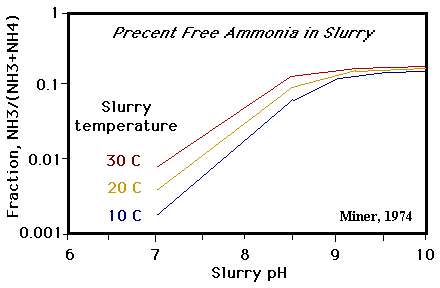
Ammonia is highly water-soluble and can largely remain in the water in the
dissociated form as ammonium. Only that part which is present in the unionized
form can become volatile and be released as a gas. The proportion of volatile
ammonia to total ammonia concentration in stored manure is a function of
manure pH and temperature. The higher the manure pH, the more ammonia is
present in the manure in volatile form. Figure 2 shows the relationships
between pH, temperature and the potential for release of ammonia gas. The
greatest increase in ammonia release occurs at high temperatures between
a pH of 7 and 10. Only small quantities are released at a pH<7. Hardly
any measurable amounts of free ammonia are present when pH4.5 is maintained.
Manure pit pH can be lowered by adding nitric acid. Other acids that can
be used are hydrochloric acid, sulfuric acid, and phosphoric acid, but nitric
acid is the most popular since the other acids affect manure quality. An
even distribution of acid is needed and it will increase the nitrogen content
of the slurry. Be very cautious in handling concentrated acids.
Chelated copper-sulfate solutions are used to slow down gas-producing bacteria.
Other chemicals which are sometimes added to pits include paraformaldehyde,
superphosphate, phosphoric acid, and acetic and propionic acid. Crystalline
hydrated aluminosilicates (zeolites) are sometimes added to adsorb ammonia
in the pits.
Well-managed and sufficient amounts of straw bedding will reduce ammonia
gas inside the building more than any other solid manure management system.
However, the overall emissions to the outside atmosphere are the same due
to higher losses during storage and spreading. More dust is found in the
building with straw, and fungal spores will dominate airborne microorganisms.
The Dutch developed and tested a manure removal system for partially-slotted
floor swine buildings in which straw bedding is used in the sleeping area
of the pens. A filter net installed beneath the slats collected the solid
manure and straw, but allowed the urine and waste water to drain into the
pit. Both fractions were daily removed from the barn. Odor was reduced by
50% in the building with the manure solids separation system compared to
a similar building with under-slat manure storage.
Building Hygiene
Good building hygiene reduces ammonia emissions by reducing the amount of
manure-covered surface area. This includes the pig's skin. The warm body
of an animal, when covered with wet manure, makes an area of accelerated
bacterial growth and ammonia production which is quickly vaporized into
the air by body heat. Keep pigs clean and dry.
Feed Management
Phase feeding with addition of synthetic amino acids can reduce ammonia
emissions, Table 3. Less manure through more efficient feed utilization
by the animal is a side benefit on top of the nutritional benefits.
Substances added to the slurry (2 oz/100 ft3 slurry at a cost
of $114/gal) or to the feed to reduce the release of ammonia from the manure
have not yet been tested over long periods and their effectiveness is still
debated. Substances added to the feed appear to have a greater effect than
slurry additives. It is very difficult to compare and evaluate reports about
the use of these substances since there is presently no established test
procedure for them.
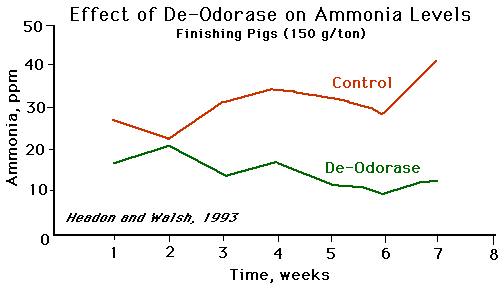
Feed additives based on yucca extracts are incorporated in the feed at low
levels (4 oz/ton, costs about $10.50/lb). The additional costs are about
$1.35-$1.50/ton of grow-finish diets. Yucca extracts bind ammonia and prevents
its release. Ammonia levels are reduced by 1/3 to 1/2 according to recent
tests, Figure 3.